Ask ten writers the same question and you’ll probably hear ten different answers. Some swear by short, punchy posts. Others won’t publish anything under 2,000 words. So what is the ideal length of an article, really? The honest answer is less rigid than people expect—and that’s actually good news.
The ideal article length isn’t a fixed number. It depends on why you’re writing, who you’re writing for, and what the reader expects to walk away with. Once you understand those pieces, choosing the right length becomes far easier than chasing a “magic” word count.

Why Article Length Even Matters?
Article length affects more than just how long someone stays on a page. It shapes readability, depth, engagement, and even how search engines interpret your content. Too short, and readers may feel shortchanged. Too long, and they may bounce before reaching the useful part. Many people asking what is the ideal length of an article are really trying to solve one of these problems:
- Their posts aren’t ranking
- Readers aren’t staying long enough
- Content feels thin or bloated
- They’re unsure how much detail is “enough”
Length isn’t the solution by itself, but it’s often a strong signal of content quality when used correctly.
There’s No Universal “Perfect” Article Length
Here’s a truth experienced writers learn early: the perfect article length changes with context. A quick tutorial doesn’t need the same word count as a deep-dive guide. A landing page doesn’t read like a blog post. Audience intent changes everything.
For example, a reader looking for blog writing services wants clarity, proof, and direction—without fluff. That kind of content usually lands in the medium-length range, offering enough depth to build trust while staying skimmable.
This is why average article length statistics should be treated as guidelines, not rules.
Ideal Article Length Based on Content Type
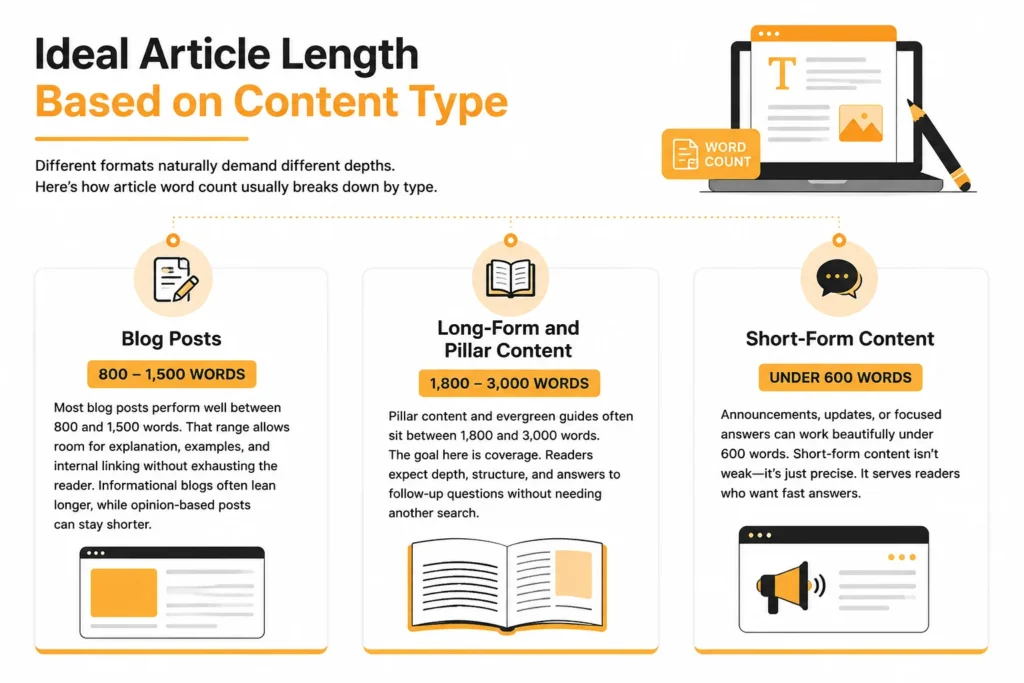
Different formats naturally demand different depths. Here’s how article word count usually breaks down by type.
Blog Posts
Most blog posts perform well between 800 and 1,500 words. That range allows room for explanation, examples, and internal linking without exhausting the reader. Informational blogs often lean longer, while opinion-based posts can stay shorter.
When writing web content writing pieces such as service pages or informational website sections clarity matters more than volume. These typically fall between 500 and 1,000 words, depending on complexity.
Long-Form and Pillar Content
Pillar content and evergreen guides often sit between 1,800 and 3,000 words. The goal here is coverage. Readers expect depth, structure, and answers to follow-up questions without needing another search.
Short-Form Content
Announcements, updates, or focused answers can work beautifully under 600 words. Short-form content isn’t weak—it’s just precise. It serves readers who want fast answers.
Ideal Article Length for SEO (Without Obsessing)
Search engines don’t rank content because it hits a word count. They rank content that satisfies intent. Still, data shows that longer, well-structured content often performs better for competitive keywords. For SEO-focused writing:
- 800–1,200 words works well for low-competition topics
- 1,500–2,500 words suits competitive keywords
- 3,000+ words fits pillar content and authority pieces
The ideal article length for SEO comes down to coverage. If the topic demands examples, comparisons, and explanations, longer content earns better dwell time and lower bounce rates.
How Audience Changes the Ideal Length?
Readers aren’t identical, and neither are their expectations.
- Beginners prefer clearer explanations, more examples, and slightly longer content
- Experts often want concise insights and skip the basics
- Busy professionals appreciate scannable sections and tight writing
- Curious learners enjoy detailed walkthroughs
That’s why article length by audience matters just as much as topic. Writing for a general audience usually lands in the safe middle range thorough, but not overwhelming.
Website content is where first impressions are made. One confusing sentence can lose a lead. These are best website content writing services built around clarity. Pages are structured to guide readers, not overwhelm them. Headlines explain. Paragraphs flow. Calls-to-action don’t feel pushy.
Real Examples That Make It Click
about recipes online. A quick sauce recipe doesn’t need 2,000 words. But a guide on sourdough baking absolutely does. The same logic applies across niches.
A guide offering ebook writing tips naturally runs longer because it covers planning, structure, formatting, and publishing considerations. Shortening it would reduce its value.
Meanwhile, a product comparison or announcement can stay tight and focused without losing impact.
Pros and Cons of Short vs Long Articles
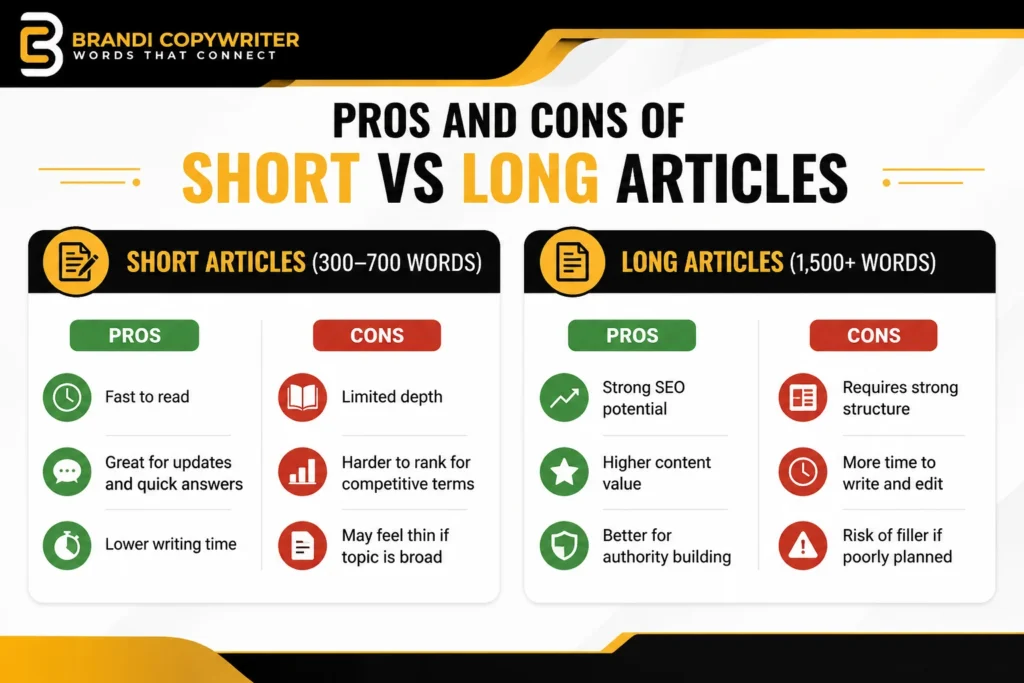
Short Articles (300–700 words)
Pros
Fast to read
Great for updates and quick answers
Lower writing time
Cons
Limited depth
Harder to rank for competitive terms
May feel thin if topic is broad
Long Articles (1,500+ words)
Pros
Strong SEO potential
Higher content value
Better for authority building
Cons
Requires strong structure
More time to write and edit
Risk of filler if poorly planned
Platform-Specific Article Length Guidelines
Different platforms shape reader behavior.
- WordPress blogs: 1,000–2,000 words performs well
- Medium: 1,200–2,000 words keeps readers engaged
- LinkedIn articles: 600–1,200 words fits professional attention spans
- Landing pages: 400–900 words depending on intent
A detailed guide on product description writing doesn’t need to be massive. It needs clarity, persuasion, and relevance—usually best achieved in a focused format.
How to Decide the Ideal Length Before Writing?
Instead of counting words, ask these questions:
- What problem am I solving?
- What questions will the reader ask next?
- Can someone act after reading this?
- Would cutting sections reduce clarity?
If you can answer those honestly, you’ll naturally land close to the optimal article length.
Tools and analytics help, but instinct and experience matter just as much. Watching how readers behave scroll depth, time on page, comments teaches you more than word count rules ever will.
Safety: Avoid Writing Just to Hit a Number
One of the biggest mistakes writers make is padding content to meet an arbitrary length. Readers notice. So do search engines.
Signs your article is too long:
- Repeated ideas
- Forced transitions
- Sections that don’t add insight
Signs it’s too short:
- Vague explanations
- Missing examples
Unanswered follow-up questions
If you’re writing for a brand like brandi copywriter, content quality always wins over volume. Clean structure, natural flow, and genuine expertise matter more than an inflated word count.
Common Questions People Ask About Content Writing
1. Are cheap article writing services worth it?
Cheap often means rushed. Affordable article writing services work only when quality isn’t compromised.
2. What’s the difference between article review writing services and blog writing?
Article review writing service focuses on analysis. Blogs focus on engagement and education.
3. Can I outsource content writing services safely?
Yes, when you choose writers who research, revise, and communicate clearly.
4. Do SEO writing services still work in 2025?
Yes, but only when content sounds human and serves real intent.
5. How long does content take to rank?
Usually weeks to months, depending on competition and consistency.
6. Are professional blog writing services good for small businesses?
They’re often one of the best long-term investments.
Cheap often means rushed. Affordable article writing services work only when quality isn’t compromised.
Article review writing service focuses on analysis. Blogs focus on engagement and education.
Yes, when you choose writers who research, revise, and communicate clearly.
Yes, but only when content sounds human and serves real intent.
Usually weeks to months, depending on competition and consistency.
They’re often one of the best long-term investments.
So, What Is the Ideal Length of an Article?
The ideal article length is the amount of space needed to fully answer the reader’s question—no more, no less. For most blogs, that falls between 800 and 1,800 words, but context always comes first.
If the content feels complete, useful, and readable, you’re likely right where you need to be.
About the Author
Brandi Marcene is a professional copywriter and content strategist providing high-quality, result-oriented services in article writing, blog writing, web content writing, product description writing, SEO optimization, and content strategy services. Her work focuses on clarity, engagement, and real-world results—content written to perform, not just exist.