
Introduction: Why Most eCommerce Content Fails to Generate Sales
Many eCommerce businesses invest heavily in product listings, social media posts, and advertising campaigns. Yet despite their efforts, traffic remains inconsistent, conversions stay low, and customer acquisition costs continue to rise.
The problem is often not the products.
It’s the content strategy. Many online stores focus only on selling. Every page, post, and campaign is designed to push products. While sales-focused content has its place, modern buyers expect more. They want information, guidance, comparisons, reviews, and answers before making a purchase decision. Without a strategic content plan, eCommerce brands struggle to build trust, attract organic traffic, and move potential customers through the buying journey. This is where a strong eCommerce content strategy becomes essential.
A well-planned content strategy helps online stores attract qualified visitors, educate buyers, improve search visibility, and increase conversions. Instead of relying entirely on paid advertising, businesses can create content assets that continue generating traffic and sales over time.
In this guide, you’ll learn what an eCommerce content strategy is, why it matters, and how to build one that supports long-term growth.
What Is an eCommerce Content Strategy?
An eCommerce content strategy is a structured plan for creating, publishing, and distributing content that supports the customer journey and business goals.
Rather than publishing content randomly, businesses create content with specific objectives such as:
- Increasing organic traffic
- Improving search rankings
- Educating potential buyers
- Building brand authority
- Generating leads
- Increasing product sales
- Improving customer retention
A successful strategy aligns content with different stages of the buying process, ensuring customers receive the information they need before making a purchasing decision.
The goal is not simply to create content. The goal is to create content that influences buying behavior and supports revenue growth.
Why eCommerce Businesses Need a Content Strategy
Customers Research Before Buying
Modern consumers rarely make purchasing decisions immediately.They compare products, read reviews, search for solutions, and explore alternatives before committing to a purchase. Without helpful content, your business may never become part of that research process.
Educational blog posts, buying guides, comparison articles, and product-focused resources help position your brand in front of potential customers before they are ready to buy. This creates trust and increases the likelihood of conversion when the customer is prepared to make a decision.
SEO Traffic Reduces Dependence on Paid Ads
Paid advertising can drive results quickly, but it becomes expensive over time.
An effective eCommerce content strategy helps businesses generate organic traffic through search engines. By targeting relevant keywords and customer questions, online stores can attract visitors without paying for every click.
Over time, this creates a more sustainable marketing system where content continues delivering traffic long after publication. Businesses that invest in content often benefit from lower acquisition costs and stronger long-term visibility. Content Builds Brand Authority Customers are more likely to buy from businesses they trust. Publishing valuable content demonstrates expertise and helps establish credibility within your niche.
Whether you’re selling electronics, fashion, health products, home goods, or software, educational content positions your brand as a helpful resource rather than just another seller. Authority influences purchasing decisions and strengthens customer loyalty.
Key Components of an eCommerce Content Strategy
Product-Focused Content
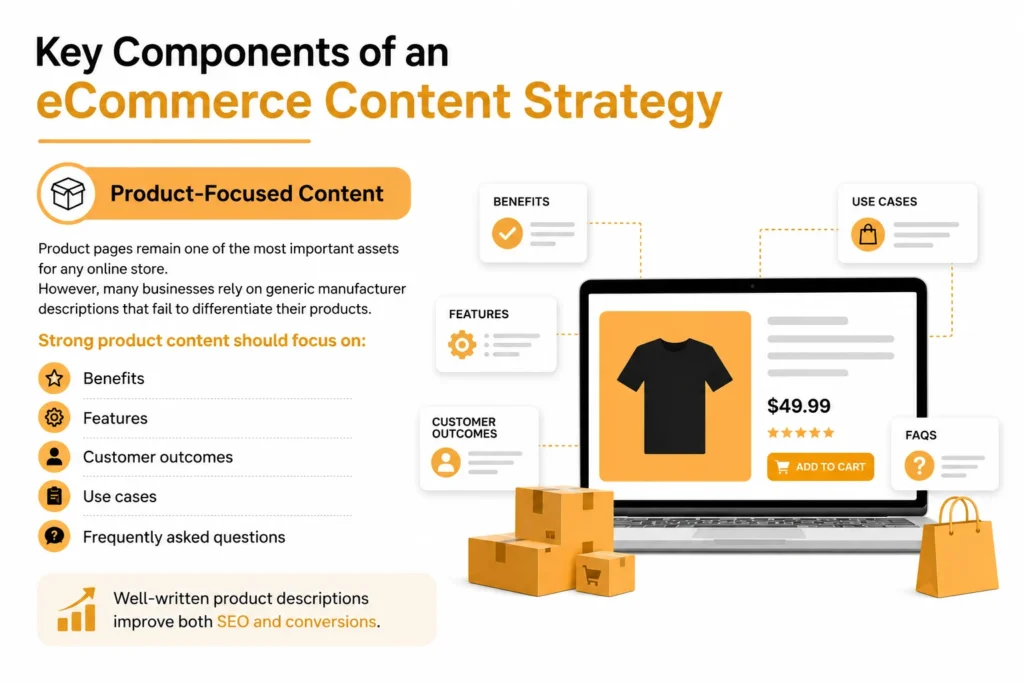
Product pages remain one of the most important assets for any online store. However, many businesses rely on generic manufacturer descriptions that fail to differentiate their products.
Strong product content should focus on:
- Benefits
- Features
- Customer outcomes
- Use cases
- Frequently asked questions
Well-written product descriptions improve both SEO and conversions.
Category Page Content
Category pages are often overlooked despite their importance.
Optimized category content helps search engines understand your offerings while helping shoppers navigate products more effectively. Strategic category pages target broader keywords while guiding visitors toward specific purchasing decisions.
Educational Blog Content
Blogging remains one of the most powerful tools in eCommerce content marketing.
Educational articles help businesses attract users at different stages of the buyer journey.
Examples include:
- Buying guides
- Product comparisons
- Industry trends
- How-to articles
- Product care tips
- Frequently asked questions
This content expands keyword visibility while building trust with potential customers.
User-Generated Content
Customer reviews, testimonials, and user-submitted photos create social proof.Shoppers trust other customers because they provide authentic experiences and unbiased feedback. Encouraging user-generated content can improve both credibility and conversion rates.
Understanding the eCommerce Buyer Journey
An effective content strategy supports customers through every stage of the purchasing process.
Awareness Stage
At this stage, potential customers recognize a problem or need.
Content examples include:
- Educational blog posts
- Industry insights
- Problem-solving guides
The goal is to attract attention and provide value.
Consideration Stage
Buyers begin evaluating options.
Content examples include:
- Product comparisons
- Reviews
- Case studies
- Buying guides
The goal is to build trust and demonstrate value.
Decision Stage
The customer is ready to purchase.
Content examples include:
- Product descriptions
- Testimonials
- FAQs
- Product demonstrations
The goal is to remove objections and encourage action.
Best SEO Practices for eCommerce Content Strategy
Target Long-Tail Keywords
Long-tail keywords often have stronger purchase intent.
Examples include:
- Best running shoes for beginners
- Affordable home office furniture
- Organic skincare products for sensitive skin
These keywords attract more qualified traffic.
Optimize for Search Intent
Every page should align with the user’s objective. Some users want information. Others want comparisons. Others are ready to buy.
Understanding intent improves content performance and conversion rates.
Build Internal Links
Strategic internal linking helps search engines understand your website structure while improving navigation for users. Links between blogs, category pages, and product pages strengthen overall SEO performance.
Common eCommerce Content Strategy Mistakes
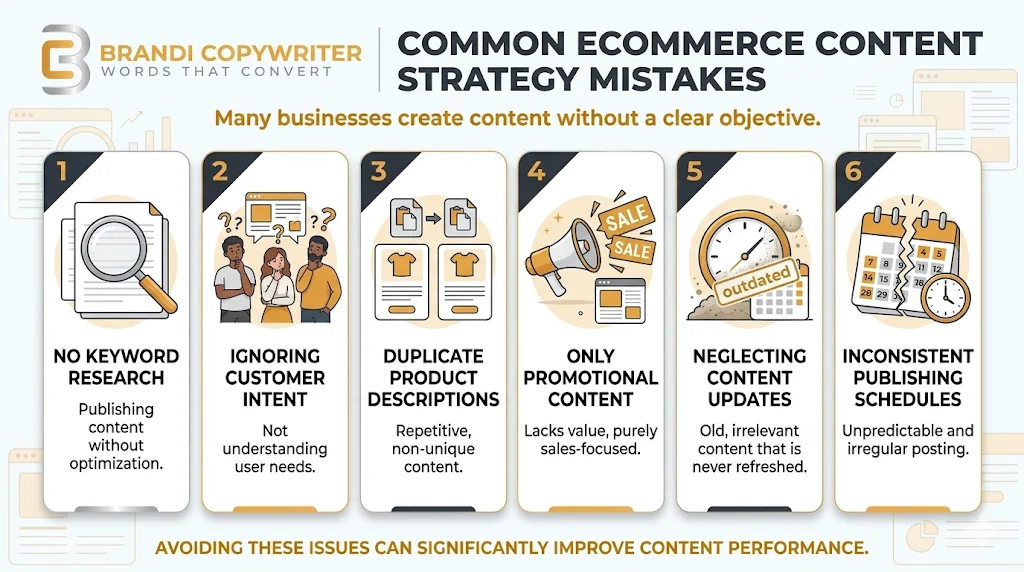
Many businesses create content without a clear objective.
Common mistakes include:
- Publishing without keyword research
- Ignoring customer intent
- Using duplicate product descriptions
- Focusing only on promotional content
- Neglecting content updates
- Inconsistent publishing schedules
Avoiding these issues can significantly improve content performance.
Why Businesses Choose Brandi Marcene for eCommerce Content Strategy
Creating content is easy.
Creating content that drives traffic and sales requires strategy.
At Brandi Marcene, eCommerce content is developed with a clear focus on SEO, customer psychology, and conversion optimization. Every piece of content is designed to support visibility, trust, and revenue growth.
With 12+ years of experience in copywriting, SEO, content marketing, and conversion-focused messaging, Brandi helps eCommerce businesses create content systems that attract qualified buyers and move them through the sales funnel.
From product descriptions and category pages to blog strategies and buyer guides, every content asset is built with business results in mind.
Ready to Build an eCommerce Content Strategy That Drives Sales?
Work With Brandi Marcene to create content that attracts customers, improves rankings, and supports long-term growth.
The Long-Term Value of a Strong eCommerce Content Strategy
A successful content strategy does more than increase traffic.
It helps businesses:
- Build authority
- Reduce advertising dependence
- Improve customer trust
- Increase organic visibility
- Support repeat purchases
- Generate sustainable growth
Unlike short-term campaigns, strategic content continues delivering value long after publication.
Conclusion
An effective eCommerce content strategy is one of the most powerful tools for growing an online store.
By creating content that aligns with customer needs, search intent, and business goals, brands can attract qualified traffic, build trust, and increase sales.
The most successful eCommerce businesses understand that content is not just marketing material—it’s a revenue-generating asset.
Investing in strategic content today can create measurable business results for years to come.
Ready to transform your eCommerce content into a growth engine? Work With Brandi Marcene today.