
Most blog posts fail—not because the ideas are weak, but because the structure is messy, confusing, or built without strategy. If you’re struggling to turn readers into engaged visitors or paying customers, the real issue isn’t your content—it’s how you organize it.
Understanding how to structure a perfect blog post is what separates average content from high-performing, SEO-driven assets. A well-structured blog doesn’t just share information—it guides the reader, improves readability, boosts search rankings, and naturally leads them toward action.
For businesses, startups, and entrepreneurs, mastering the right blog structure means more than just writing—it means creating content that ranks, converts, and builds authority in your niche. When done right, every section of your blog works together to increase organic traffic, keep visitors engaged, and strengthen your brand presence online.
Writing a blog post is easy.
That’s why understanding how to structure a perfect blog post is essential for businesses, marketers, and content creators who want their content to perform—not just exist.

A well-structured blog post improves:
- Search engine rankings
- Reader engagement
- Time on page
- Conversion rates
- Content clarity and professionalism
In this guide, you’ll learn exactly how to structure blog posts for SEO, readability, and better marketing performance.
Why Blog Structure Matters
Even great information can fail if presented poorly.
Modern readers skim before they commit to reading.
A structured blog post helps:
- Capture attention quickly
- Improve readability
- Make content easier to scan
- Increase content retention
- Support search engine optimization
Poor structure often causes visitors to bounce—even when the content is valuable.
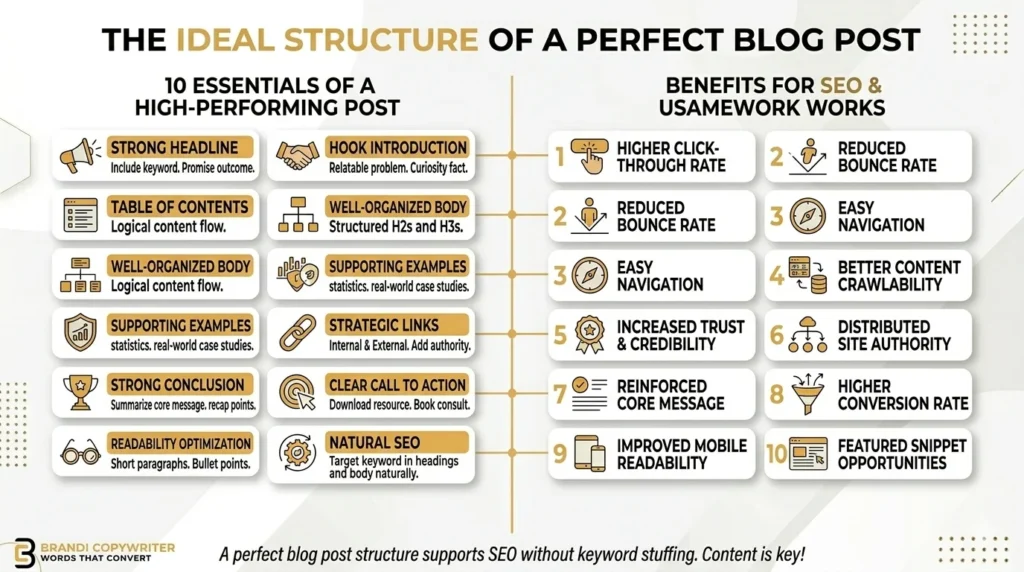
The Ideal Structure of a Perfect Blog Post
A high-performing blog post generally follows this proven framework:
- Compelling headline
- Strong introduction/hook
- Clear table of contents or logical flow
- Well-organized body sections
- Supporting examples/data
- Strategic internal/external links
- Strong conclusion
- Clear call to action
Let’s break down each element.
1. Start With a Strong, Keyword-Optimized Headline
Your headline affects both clicks and SEO.
A strong headline should:
- Include the target keyword
- Promise value or outcome
- Spark curiosity
- Match search intent
Example:
How to Structure a Perfect Blog Post for SEO and Conversions
Good headlines improve click-through rates.
2. Write a Hook-Driven Introduction
Your intro must convince readers to keep going.
Effective intros include:
- A pain point
- A relatable problem
- A surprising fact
- A strong promise
Example:
Most blog posts fail not because the ideas are bad—but because the structure makes them difficult to read and impossible to rank.
Then explain what the reader will learn.
3. Use Clear H2 and H3 Subheadings
Subheadings improve:
- Readability
- SEO structure
- User navigation
- Featured snippet opportunities
Use headings to organize your content logically.
Example:
- H2: Why Blog Structure Matters
- H2: Essential Elements of a Great Blog Post
- H3: Writing Better Introductions
4. Keep Paragraphs Short and Scannable
Large text blocks reduce readability.
Best practices:
- 1–3 sentences per paragraph
- Use white space generously
- Break complex ideas into sections
This improves mobile readability especially.
5. Add Bullet Points and Lists
Lists improve scannability and retention.
Use bullet points for:
- Steps
- Tips
- Benefits
- Comparisons
- Key takeaways
Example:
Benefits of structured blog posts:
- Better UX
- Higher engagement
- Improved rankings
- Increased conversions
6. Support Points With Examples or Proof
Strong blog posts do not just make claims—they support them.
Use:
- Examples
- Statistics
- Mini case studies
- Real-world applications
- Expert insights
This increases trust and authority.
7. Optimize for SEO Naturally
A perfect blog post structure supports SEO without keyword stuffing.
Include your focus keyword in:
- Title
- Introduction
- At least one H2
- Naturally throughout body copy
- Conclusion
Also optimize:
- Internal links
- Image alt text
- Meta title/description
- URL slug
8. Add Internal and External Links
Strategic linking improves SEO and UX.
Internal Links Help:
- Distribute authority across pages
- Improve crawlability
- Keep users on site longer
External Links Help:
- Support claims
- Add credibility
- Improve content trustworthiness
Use links strategically—not excessively.
9. End With a Strong Conclusion
Summarize key takeaways clearly.
A good conclusion should:
- Reinforce the core message
- Recap major points
- Transition naturally into CTA
Avoid abrupt endings.
10. Include a Conversion-Focused CTA
Every blog should have a purpose.
Guide readers toward next steps:
Examples:
- Book a consultation
- Contact your team
- Download a resource
- Explore services
- Read related content
Without a CTA, traffic may leave without converting.
Bonus Tips for Structuring High-Performing Blog Posts
Use Table of Contents for Long Posts
Helpful for:
- User navigation
- Featured snippets
- Better UX
Include FAQ Section
Benefits:
- Targets long-tail keywords
- Improves semantic SEO
- Increases topical authority
Add Visual Breaks
Use:
- Images
- Graphics
- Pull quotes
- Charts
- Videos
- Visuals improve engagement.
- Common Blog Structure Mistakes to Avoid
- Writing Walls of Text
- Dense formatting discourages reading.
- Weak Introductions
- If the intro does not hook readers, they bounce.
- Poor Heading Hierarchy
- Disorganized headings confuse users and search engines.
- No Clear CTA
- Traffic without conversion strategy wastes opportunity.
- Ignoring Search Intent
- Structure must align with what the user wants to learn.
- Why Blog Structure Impacts SEO and Conversions
- Good structure improves:
Good structure improves:
- Dwell time
- User experience
- Readability
- Engagement
- Search engine understanding
- Conversion opportunities
Better structure supports both rankings and ROI.
How Professional Copywriters Structure Blog Content Strategically
Professional writers understand how to structure content for:
- Search intent
- SEO optimization
- Persuasive flow
- User psychology
- Conversion pathways
This is why professionally written blogs often outperform DIY content.
Brandi Copywriter’s SEO Blog Writing Services
At Brandi Copywriter, we create strategic blog content structured to rank, engage, and convert.
Services include:
- SEO Blog Writing
- Content Strategy Development
- Blog Optimization
- Conversion-Focused Copywriting
- Long-Form Authority Content
Whether you need educational blogs, lead-gen content, or topical authority articles, strategic blog writing helps maximize performance.
Final Thoughts on How to Structure a Perfect Blog Post
Learning how to structure a perfect blog post can dramatically improve your content’s performance.
Remember:
- Start with a compelling headline
- Hook readers immediately
- Use organized headings
- Make content scannable
- Support claims with proof
- End with a CTA
Strong structure turns average content into content that ranks, engages, and converts.
Ready to Improve Your Blog Content?
If your blog posts are not ranking or converting, structure and messaging may be the problem.
Brandi Copywriter creates strategic SEO blog content designed to improve visibility, engagement, and conversions.
👉 Contact Brandi today for professional blog writing services.