
Many businesses use the terms “blog” and “article” interchangeably.
While they may seem similar, understanding the blog writing vs article writing difference is important if you want to build the right content strategy for SEO, brand authority, and audience engagement.
Both formats can educate readers and support marketing goals—but they serve different purposes, follow different structures, and often appeal to audiences in different ways.
In this guide, we’ll explain how blog writing and article writing differ, when to use each, and how businesses can choose the right format for their content strategy.
What Is Blog Writing?
Blog writing refers to creating content typically published on a business or personal website’s blog section.
Blogs are generally:
- Conversational in tone
- Informational or educational
- SEO-focused
- Structured for online readability
- Designed to engage and convert readers
Businesses use blog writing to:
- Drive organic traffic
- Build topical authority
- Educate potential customers
- Support lead generation
- Improve search rankings
Blogs are often part of a broader content marketing strategy.
What Is Article Writing?
Article writing usually refers to more formal, structured informational content written for:
- Publications
- Magazines
- News sites
- Industry journals
- Editorial platforms
- Authority websites
Articles are often:
- More formal in tone
- Less promotional
- More research-driven
- Written for publication standards
- Focused on informing rather than converting
Articles may be educational, journalistic, or editorial.
Blog Writing vs Article Writing Difference Explained
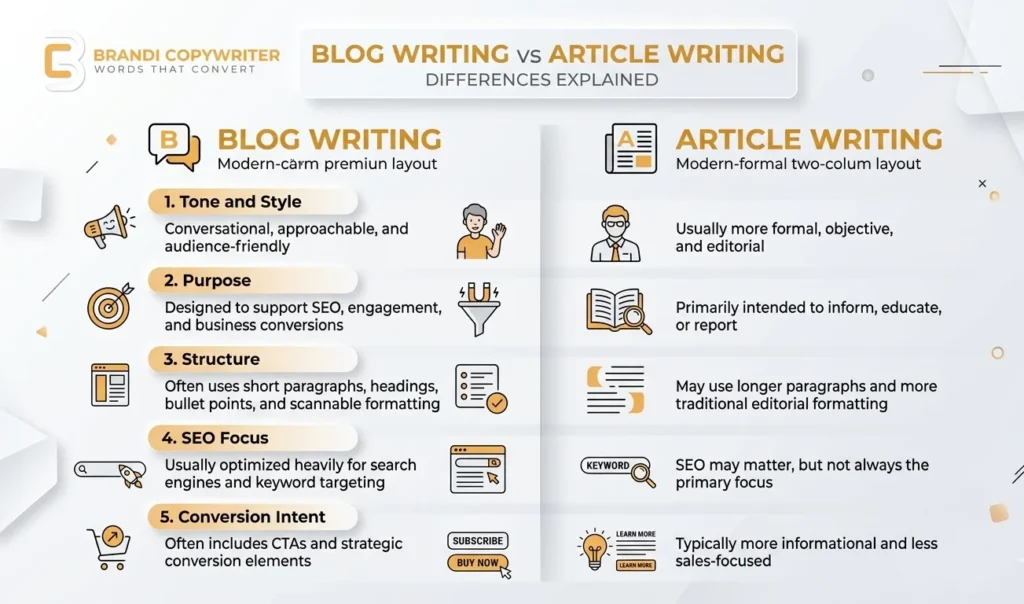
1. Tone and Style
Blog Writing:
Typically conversational, approachable, and audience-friendly.
Article Writing:
Usually more formal, objective, and editorial in tone.
2. Purpose
Blog Writing:
Designed to support SEO, engagement, and business conversions.
Article Writing:
Primarily intended to inform, educate, or report.
3. Structure
Blog Writing:
Often uses short paragraphs, headings, bullet points, and scannable formatting.
Article Writing:
May use longer paragraphs and more traditional editorial formatting.
4. SEO Focus
Blog Writing:
Usually optimized heavily for search engines and keyword targeting.
Article Writing:
SEO may matter, but not always the primary focus.
5. Conversion Intent
Blog Writing:
Often includes CTAs and strategic conversion elements.
Article Writing:
Typically more informational and less sales-focused.
When Businesses Should Use Blog Writing
Blog writing is ideal when your goal is to:
- Improve SEO rankings
- Generate organic traffic
- Build topical authority
- Educate prospects
- Nurture leads
- Support service/product pages
For most businesses, blogs are a core part of digital marketing.
When Businesses Should Use Article Writing
Article writing may be better when your goal is to:
- Publish thought leadership externally
- Contribute to publications
- Build PR/brand credibility
- Educate niche audiences in editorial formats
- Create industry reports or insights
Articles often support authority and reputation building.
Similarities Between Blog Writing and Article Writing
Despite their differences, both should aim to:
- Provide valuable information
- Be well researched
- Use clear structure
- Address audience needs
- Demonstrate expertise
The main distinction is strategic purpose and format.
Which Is Better for SEO: Blog or Article Writing?
For most business websites:
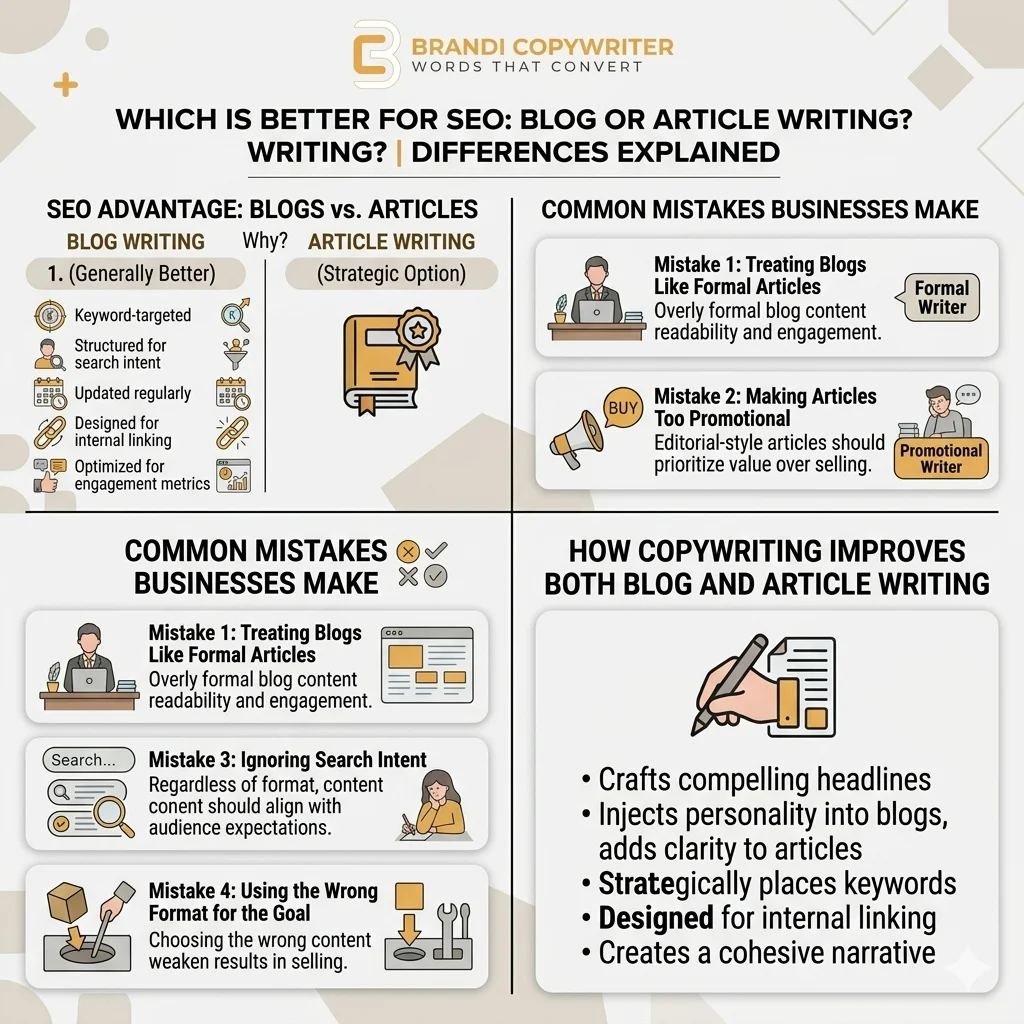
Blog writing is generally better for SEO.
Why?
Because blogs are typically:
- Keyword-targeted
- Structured for search intent
- Updated regularly
- Designed for internal linking
- Optimized for engagement metrics
However, authoritative long-form articles can also rank well if optimized strategically.
For example;
- Common Mistakes Businesses Make
- Treating Blogs Like Formal Articles
- Overly formal blog content often reduces readability and engagement.
- Making Articles Too Promotional
- Editorial-style articles should prioritize value over selling.
- Ignoring Search Intent
- Regardless of format, content should align with audience expectations.
- Using the Wrong Format for the Goal
- Choosing the wrong content type can weaken results.
- How Copywriting Improves Both Blog and Article Writing
Strategic copywriting enhances both formats by improving:
- Clarity
- Engagement
- Structure
- Reader retention
- Persuasive flow
- Conversion opportunities
Even informational content benefits from a strong writing strategy.
Why Businesses Hire Professional Content Writers
Professional writers understand how to adapt content style based on:
- Platform
- Audience
- Search intent
- Business goals
- Brand voice
- Conversion strategy
This ensures the content matches its intended purpose.
Brandi Copywriter’s Blog and Article Writing Services
At Brandi Copywriter, we help businesses create strategic written content tailored to their goals.
Services include:
- SEO Blog Writing
- Long-Form Article Writing
- Thought Leadership Content
- Authority Content Strategy
- Conversion-Focused Content Writing
Whether you need traffic-generating blogs or authoritative articles, strategic writing improves results.
Final Thoughts on Blog Writing vs Article Writing Difference
Understanding the blog writing vs article writing difference helps businesses choose the right format for their content strategy.
Remember:
- Blogs are conversational, SEO-focused, and conversion-driven
- Articles are more formal, informational, and editorial
- Both serve valuable but different purposes
- Choosing the right format depends on your goals
Using the right content type strategically can improve both marketing performance and audience engagement.
Ready to Create Better Content for Your Business?
If you need strategic blog or article writing that aligns with your business goals—
Brandi Copywriter creates SEO-focused and authority-building content designed to rank, engage, and convert.
👉 Contact Brandi today for professional content writing services.