
how to write a high-quality blog post? Anyone can publish a blog post. But writing one that actually ranks in search engines, keeps readers engaged, and helps grow your business requires far more than simply putting words on a page.
If your blog posts are getting traffic but failing to convert, the problem isn’t visibility—it’s weak, unfocused content that doesn’t move readers to act. Every poorly written article is costing you lost leads, lower search rankings, and missed revenue opportunities while your competitors capture the attention you’re leaving behind. In today’s competitive digital space, publishing “just content” is no longer enough—you need a strategic, high-quality blog post that engages, persuades, and converts. The good news? With the right approach, you can turn underperforming content into a powerful growth asset—and if you’re ready to start seeing real results, now is the time to Get High-Converting Blog Content or work with a professional who knows how to turn words into conversions.

High-quality blog content helps businesses:
- Improve search engine rankings
- Build authority in their niche
- Educate potential customers
- Generate organic traffic
- Convert readers into leads
In this guide, you’ll learn the exact process professional copywriters use to create blog posts that deliver value, support SEO, and drive business results.
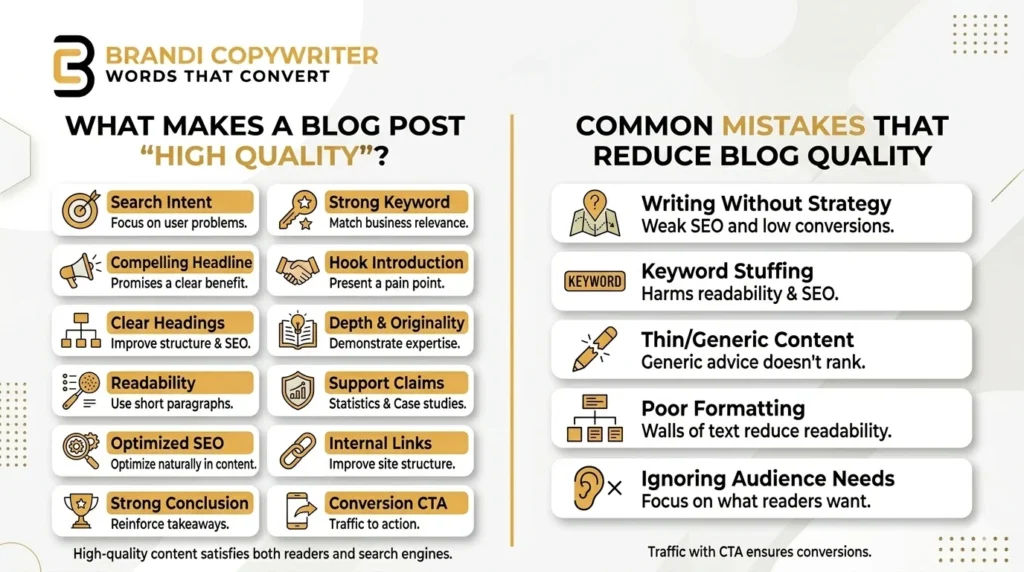
What Makes a Blog Post “High Quality”?
A high-quality blog post does more than provide information.
It delivers value in a way that is:
- Well researched
- Easy to read
- Strategically structured
- Search optimized
- Audience-focused
- Conversion-oriented
High-quality content satisfies both readers and search engines.

Step 1: Start With Search Intent
Before writing anything, understand why someone is searching for the topic.
Ask:
- What problem are they trying to solve?
- What information do they expect?
- What format do top-ranking pages use?
- Are they informational, commercial, or transactional?
Matching search intent is critical for SEO success.
Step 2: Choose a Strong Focus Keyword
Every blog should target a primary keyword.
A strong keyword should:
- Match search intent
- Have business relevance
- Align with your audience’s needs
- Support your SEO strategy
Example:
Primary Keyword: How to Write a High-Quality Blog Post
Then build the content around that topic naturally.
Step 3: Create a Compelling Headline
Your title impacts both clicks and rankings.
A strong blog headline should:
- Include the focus keyword
- Promise a clear benefit
- Be specific and compelling
Example:
How to Write a High-Quality Blog Post That Ranks and Converts
Step 4: Write a Hook-Driven Introduction
The first few lines determine whether readers continue.
Good introductions:
- Present a pain point
- Create curiosity
- Show relevance
- Promise value
Example:
Many blog posts fail not because the writer lacks expertise—but because the content lacks strategy, structure, and optimization.
Then explain what the reader will gain.
Step 5: Structure Content With Clear Headings
Break content into logical sections.
Use:
- H2s for main sections
- H3s for subtopics
- Clear topic segmentation
This improves:
- Readability
- SEO structure
- User navigation
Step 6: Focus on Depth and Original Value
Avoid surface-level advice.
High-quality content should:
- Go beyond basics
- Explain concepts thoroughly
- Offer practical insights
- Add unique perspective
- Demonstrate expertise
Thin content rarely performs well.
Step 7: Write for Readability
Readers skim online content.
Improve readability by:
- Using short paragraphs
- Adding white space
- Including bullet points
- Avoiding jargon when possible
- Writing clearly and concisely
Readable content keeps users engaged longer.
Step 8: Support Claims With Examples or Proof
Use evidence to strengthen authority.
Examples include:
- Statistics
- Case studies
- Real-world examples
- Expert insights
- Data-backed observations
This builds trust and credibility.
Step 9: Optimize for SEO Naturally
SEO optimization should support readability—not hurt it.
Include your focus keyword in:
- Title
- Introduction
- Headings
- Body content naturally
- Conclusion
Also optimize:
- Meta title
- Meta description
- URL slug
- Internal links
- Image alt text
Step 10: Add Strategic Internal Links
Internal links help:
- Improve site structure
- Distribute authority
- Increase session duration
- Guide users deeper into your site
Link to relevant pages naturally.
Step 11: End With a Strong Conclusion
Summarize the article clearly.
A good conclusion:
- Reinforces main takeaways
- Provides closure
- Transitions into CTA
Step 12: Include a Conversion CTA
Blog traffic should support business goals.
Strong CTAs may encourage readers to:
- Contact your business
- Book a consultation
- Explore services
- Read related content
- Download resources
- Without a CTA, traffic often leaves without action.
- Common Mistakes That Reduce Blog Quality
- Writing Without Strategy
- Publishing random content leads to weak SEO and low conversions.
- Keyword Stuffing
- Overusing keywords harms readability and SEO.
- Thin/Generic Content
- Generic advice does not rank or convert well.
- Poor Formatting
- Walls of text reduce readability.
- Ignoring Audience Needs
- Content should focus on what readers want—not just what you want to say.
- Why High-Quality Content Matters for SEO
- Without a CTA, traffic often leaves without action.
Search engines reward content that demonstrates:
- Relevance
- Depth
- Authority
- User satisfaction
- Engagement
Higher-quality content often leads to:
- Better rankings
- Longer dwell time
- More backlinks
- Increased conversions
Why Professional Blog Writing Helps Businesses
Professional copywriters understand how to combine:
- SEO strategy
- Search intent analysis
- Persuasive writing
- Conversion optimization
- Content structure best practices
This creates content designed to perform—not just fill space.
Brandi Copywriter’s SEO Blog Writing Services
At Brandi Copywriter, we create high-quality blog content designed to rank, engage, and convert.
Services include:
- SEO Blog Writing
- Long-Form Authority Content
- Topical Authority Content Clusters
- Conversion-Focused Blog Strategy
- Blog Optimization & Refreshing
Whether you need educational content, authority-building blogs, or SEO-driven lead generation content, strategic copywriting can improve your results.
Final Thoughts on How to Write a High-Quality Blog Post
Learning how to write a high-quality blog post is one of the most valuable skills for content marketing success.
Remember:
- Start with search intent
- Use strategic structure
- Provide real depth and value
- Optimize naturally for SEO
- Include conversion strategy
Great blog posts do not happen by accident—they are built strategically.
Ready to Publish Better Blog Content?
If your current blog content is not ranking or converting, quality and strategy may be the issue.
Brandi Copywriter creates strategic SEO blog content designed to improve visibility, authority, and conversions.
👉 Contact Brandi today for professional blog writing services.