
Introduction: Why Your Web Content Is Not Getting Results
Most websites don’t fail because of bad design—they fail because the content doesn’t hold attention.
Visitors land on the page, skim a few lines, and leave without clicking, reading, or converting. No leads. No inquiries. No sales.
The real issue is simple: the content is not engaging enough.
Learning how to write engaging web content is not just a writing skill—it’s a business growth skill. Engaging content keeps users on your website longer, builds trust faster, and guides them toward taking action.
If your website is not generating results, the problem is not traffic—it’s content engagement and messaging clarity.
This guide breaks down proven strategies used by expert copywriters to create content that captures attention, builds interest, and drives conversions.

What Is Engaging Web Content?
Engaging web content is content that:
- Captures attention immediately
- Keeps readers interested
- Answers user intent clearly
- Builds emotional connection
- Encourages action (click, sign-up, purchase)
Unlike generic content, engaging content is strategic, structured, and conversion-focused.
It is not just written for humans—it is also optimized for search engines and user behavior.
Why Engaging Web Content Matters for SEO and Business Growth
Engaging content directly impacts your business performance in multiple ways:
1. Improves SEO Rankings
Google rewards websites with:
- High dwell time
- Low bounce rate
- User engagement
Engaging content keeps users on your site longer, improving rankings.
2. Increases Conversions
When content connects emotionally and logically, users are more likely to:
- Fill contact forms
- Make purchases
- Request services
3. Builds Brand Authority
Well-written content positions your business as:
- Trustworthy
- Professional
- Industry expert
4. Enhances User Experience
Clear, engaging content improves readability and navigation, making your website easier to use.
Step 1: Understand Your Audience Deeply
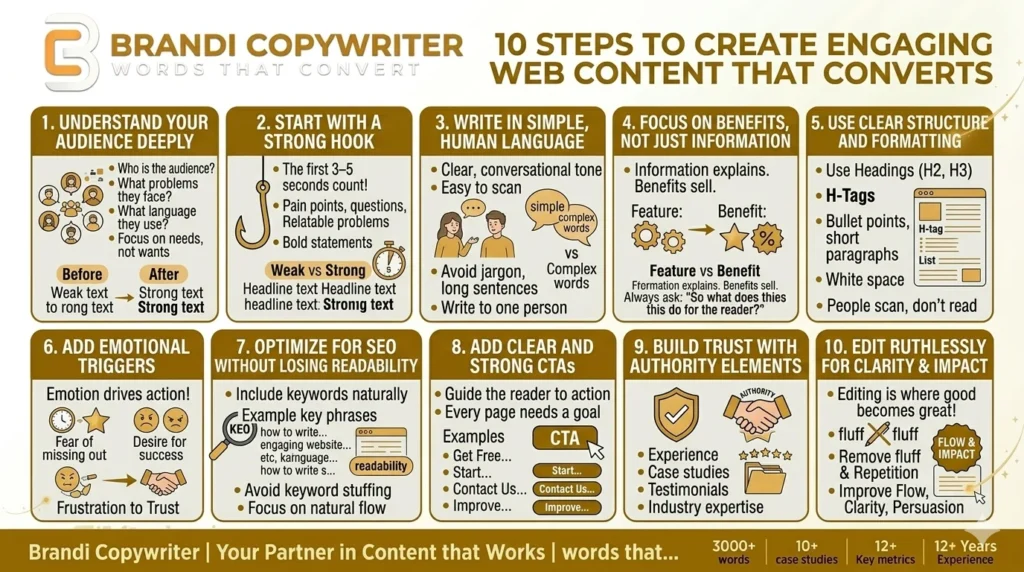
Before writing anything, you must understand:
- Who your audience is
- What problems they face
- What solutions they are looking for
- What language they use
Engaging content is not about writing what you want—it’s about writing what your audience needs.
Example:
Instead of saying:
“We offer digital solutions”
Say:
“Struggling to get online customers? Here’s how to fix it.”
Step 2: Start With a Strong Hook
The first 3–5 seconds decide whether a visitor stays or leaves.
Effective hooks include:
- Pain points
- Questions
- Bold statements
- Relatable problems
Example:
Weak:
“Welcome to our website content services.”
Strong:
“Your website is getting traffic—but no one is reading your content.”
Step 3: Write in Simple, Human Language
Engaging content is:
- Clear
- Conversational
- Easy to scan
Avoid:
- Complex jargon
- Long sentences
- Overly formal tone
Write like you are speaking to one person, not a crowd.
Step 4: Focus on Benefits, Not Just Information
Information explains. Benefits sell.
Example:
Feature:
“We write website content.”
Benefit:
“We create website content that turns visitors into paying customers.”
Always ask:
“So what does this do for the reader?”
Step 5: Use Clear Structure and Formatting
Engaging web content is easy to read.
Use:
- Headings (H2, H3)
- Bullet points
- Short paragraphs
- White space
People don’t read websites—they scan them.
Step 6: Add Emotional Triggers
Emotion drives action.
Common triggers include:
- Fear of missing opportunities
- Desire for success
- Frustration with current results
- Trust and authority
Content that connects emotionally performs better than purely logical content.
Step 7: Optimize for SEO Without Losing Readability
To rank on Google, include keywords naturally such as:
- how to write engaging web content
- engaging website content writing
- SEO web content writing tips
- conversion-focused website content
But avoid keyword stuffing—focus on natural flow.
Step 8: Add Clear and Strong CTAs
Every page should guide the reader toward action.
Examples:
- Get a Free Consultation
- Start Your Project Today
- Contact Us for Professional Content
- Improve Your Website Conversion Now
Without CTAs, even great content fails to convert.
Step 9: Build Trust With Authority Elements
Engaging content builds credibility using:
- Experience
- Case studies
- Testimonials
- Industry expertise
This helps users trust your brand faster.
Step 10: Edit Ruthlessly for Clarity and Impact
Editing is where good content becomes great.
Remove:
- Fluff
- Repetition
- Unclear messaging
Improve:
- Flow
- Clarity
- Persuasion
Why Most Businesses Fail at Writing Engaging Web Content
Most companies struggle because:
- They focus on themselves, not the customer
- They ignore SEO structure
- They don’t understand user psychology
- They write without strategy
This leads to websites that look good—but don’t perform.
How Professional Copywriting Improves Web Content Engagement
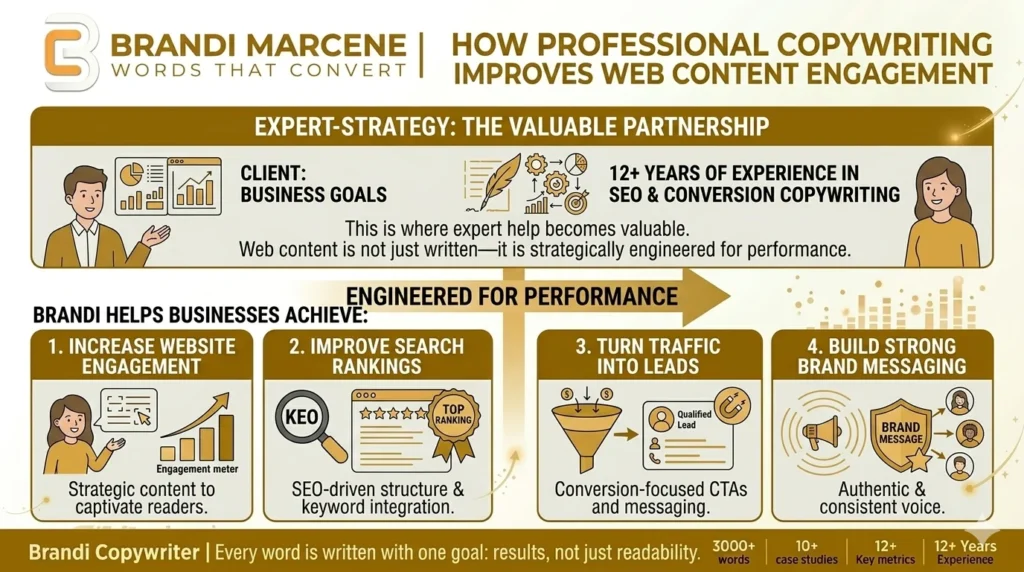
This is where expert help becomes valuable.
At Brandi Marcene, web content is not just written—it is strategically engineered for performance.
With 12+ years of experience in SEO and conversion copywriting, Brandi helps businesses:
- Increase website engagement
- Improve search rankings
- Turn traffic into leads
- Build strong brand messaging
Every word is written with one goal: results, not just readability.
Conclusion: Engagement Is the Key to Online Success
Learning how to write engaging web content is essential for any business that wants to grow online.
But engagement is not accidental—it is built through:
- Strategy
- Psychology
- SEO
- Clear messaging
- Strong structure
If your content is not engaging, your website will not perform—no matter how much traffic you get.
The businesses that win online are not the ones with the most content—they are the ones with the most effective content.