
Introduction: Your Website Is Not Performing—But You Don’t Know Why
Your website looks fine. The design is modern. The pages are live. You might even be getting some traffic.
But there’s a problem you can’t ignore anymore:
Visitors are not converting.
No leads. No inquiries. No sales.
This is where a website content audit becomes essential. Most businesses assume their issue is design or ads—but in reality, the real bottleneck is often poor, outdated, or unoptimized content that fails to perform.
A website content audit helps you identify exactly what is working, what is not, and what needs to be fixed to improve SEO rankings, user engagement, and conversions.
In this guide, you’ll learn how a professional content audit works, why it matters, and how it can transform your website into a high-performing business asset.

What Is a Website Content Audit?
A website content audit is a systematic review of all the content on your website to evaluate its:
- SEO performance
- Quality and relevance
- Engagement levels
- Conversion effectiveness
- Alignment with business goals
It helps you understand which pages are:
- Driving traffic
- Losing visitors
- Underperforming
- Need updating or removal
In simple terms:
A website content audit shows you what content is helping your business—and what is hurting it.
Why Website Content Audit Is Important for Business Growth
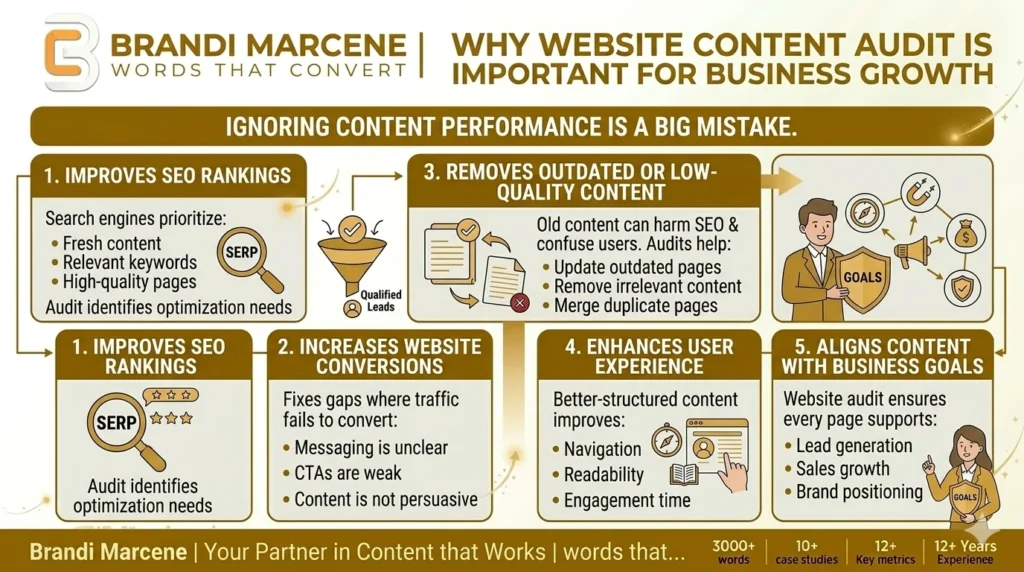
Ignoring content performance is one of the biggest mistakes businesses make.
Here’s why a content audit is critical:
1. Improves SEO Rankings
Search engines prioritize:
- Fresh content
- Relevant keywords
- High-quality pages
A content audit identifies pages that need SEO optimization.
2. Increases Website Conversions
Many websites get traffic but fail to convert because:
- Messaging is unclear
- CTAs are weak
- Content is not persuasive
A content audit fixes these gaps.
3. Removes Outdated or Low-Quality Content
Old content can harm SEO performance and confuse users.
Audits help:
- Update outdated pages
- Remove irrelevant content
- Merge duplicate pages
4. Enhances User Experience
Better-structured content improves:
- Navigation
- Readability
- Engagement time
5. Aligns Content With Business Goals
A website audit ensures every page supports:
- Lead generation
- Sales growth
- Brand positioning
What Is Included in a Website Content Audit?
A professional website content audit covers several key areas:
1. Content Performance Analysis
- Traffic data
- Bounce rate
- Time on page
- Conversion rate
2. SEO Evaluation
- Keyword usage
- Meta titles and descriptions
- Internal linking
- Search rankings
3. Content Quality Review
- Clarity
- Grammar and structure
- Relevance
- Value to the reader
4. Conversion Analysis
- CTA effectiveness
- Landing page performance
- User journey flow
5. Technical Content Issues
- Broken links
- Duplicate content
- Missing tags or headings
Step-by-Step Website Content Audit Process
Step 1: Collect All Website Pages
Start by listing all URLs from your website.
This gives a complete view of your content structure.
Step 2: Analyze Traffic and Performance Data
Use tools like Google Analytics to check:
- High-performing pages
- Low-performing pages
- Pages with high bounce rates
Step 3: Evaluate SEO Optimization
Check if your content includes:
- Focus keywords
- Proper headings (H1, H2, H3)
- Meta descriptions
- Internal links
Step 4: Assess Content Quality
Ask:
- Is the content helpful?
- Is it easy to read?
- Does it solve user problems?
Step 5: Identify Content Gaps
Find missing opportunities such as:
- Missing service pages
- Weak blog content
- Unanswered user questions
Step 6: Take Action (Update, Remove, or Improve)
Each page should be:
- Updated
- Improved
- Or removed if unnecessary
Common Problems Found in Website Content Audits
Most audits reveal similar issues:
- Weak or missing SEO optimization
- Thin or outdated content
- Poor keyword targeting
- Lack of clear CTAs
- Duplicate or irrelevant pages
- Low engagement content
Fixing these leads to immediate performance improvement.
How Website Content Audit Improves SEO and Conversions
A content audit improves performance by:
- Increasing keyword relevance
- Improving site structure
- Enhancing user experience
- Strengthening internal linking
- Optimizing conversion paths
This results in:
- Higher rankings
- More organic traffic
- Better lead generation
- Increased sales
DIY vs Professional Website Content Audit
DIY Audit
- Basic review
- Limited SEO insight
- No deep conversion analysis
Professional Audit
- Full SEO + content strategy review
- Conversion optimization analysis
- Competitor benchmarking
- Actionable improvement plan
Why Businesses Choose Brandi Marcene for Website Content Audit
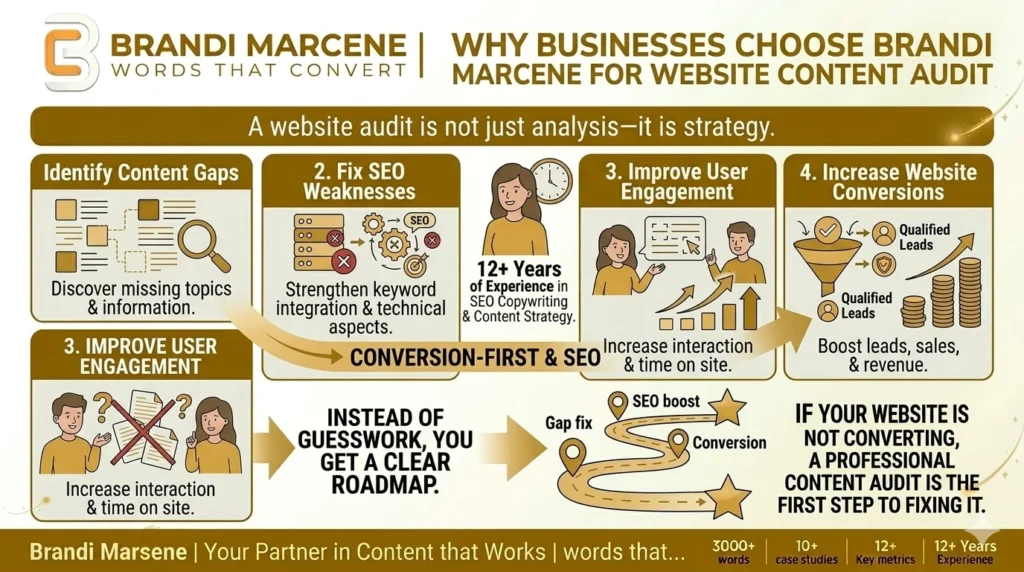
A website audit is not just analysis—it is strategy.
At Brandi Marcene, website content audits are performed with a conversion-first and SEO-driven approach.
With 12+ years of experience in SEO copywriting and content strategy, Brandi helps businesses:
- Identify content gaps
- Fix SEO weaknesses
- Improve user engagement
- Increase website conversions
Instead of guesswork, you get a clear roadmap for content performance improvement.
If your website is not converting, a professional content audit is the first step to fixing it.
Conclusion: Your Website Is Only as Strong as Its Content
A website content audit is not optional—it is essential for any business that wants to grow online.
It helps you understand:
- What content is working
- What is failing
- What needs improvement
Without it, you are making decisions blindly.
With it, you gain clarity, direction, and measurable growth.
If your website is not performing, don’t redesign it—audit the content first.